- Published on
Intent Over Artifact: Authenticating Evidence in the Deepfake Era
A recent civil proceeding in a California courtroom produced a small but significant moment. A party introduced video of a witness as authentic testimony. The judge noticed a face that barely moved, expressions that repeated, metadata that did not match the device the footage supposedly came from, and flagged it as AI-generated. Sanctions followed. Legal commentary calls it one of the first American cases in which a fabricated video was submitted as real evidence and identified as synthetic before it did lasting damage.
The reassuring read is that the system worked. The more useful read is that the system got lucky. The fake was caught because it was, by 2026 standards, crude, and because the judge happened to look closely. What about every proceeding, and every investigation feeding into one, where no one looks that hard, or where the synthesis is better?
- The Default Has Flipped, and It Cuts Both Ways
- Single-Artifact Detection Is the Wrong Battle
- The Legal Scaffolding Is Forming, Slowly
- Provenance, Correlation, Judgment
- What This Means for Practice
- Closing
The Default Has Flipped, and It Cuts Both Ways
For most of the modern investigative era, digital media was presumed authentic unless a specific reason to doubt it arose. Fabricating convincing photos, audio, or video was expensive enough to act as a quiet gatekeeper on what ended up in a case file. That gatekeeper is gone. A laptop and a consumer model now produce media that would have required a state-grade effort five years ago.
Legal scholars call the resulting condition the liar's dividend. Once fakes are plausible at scale, all digital evidence becomes suspect, including the genuine kind. The logic is unforgiving and it runs in both directions. A fabricator benefits when their fake passes as real. A wrongdoer benefits when real evidence can be plausibly dismissed with the phrase "that could be a deepfake." Defense attorneys are already using this leverage, and there is a term in circulation for it. Opposing counsel no longer needs to prove fabrication. They only need to suggest it, and the suggestion is free.
The structural shift is that the presumption of authenticity which underwrites every downstream process, from collection to charging to trial, has quietly reversed. Investigations, intelligence products, and regulatory enforcement are now happening on contested epistemic ground.
Single-Artifact Detection Is the Wrong Battle
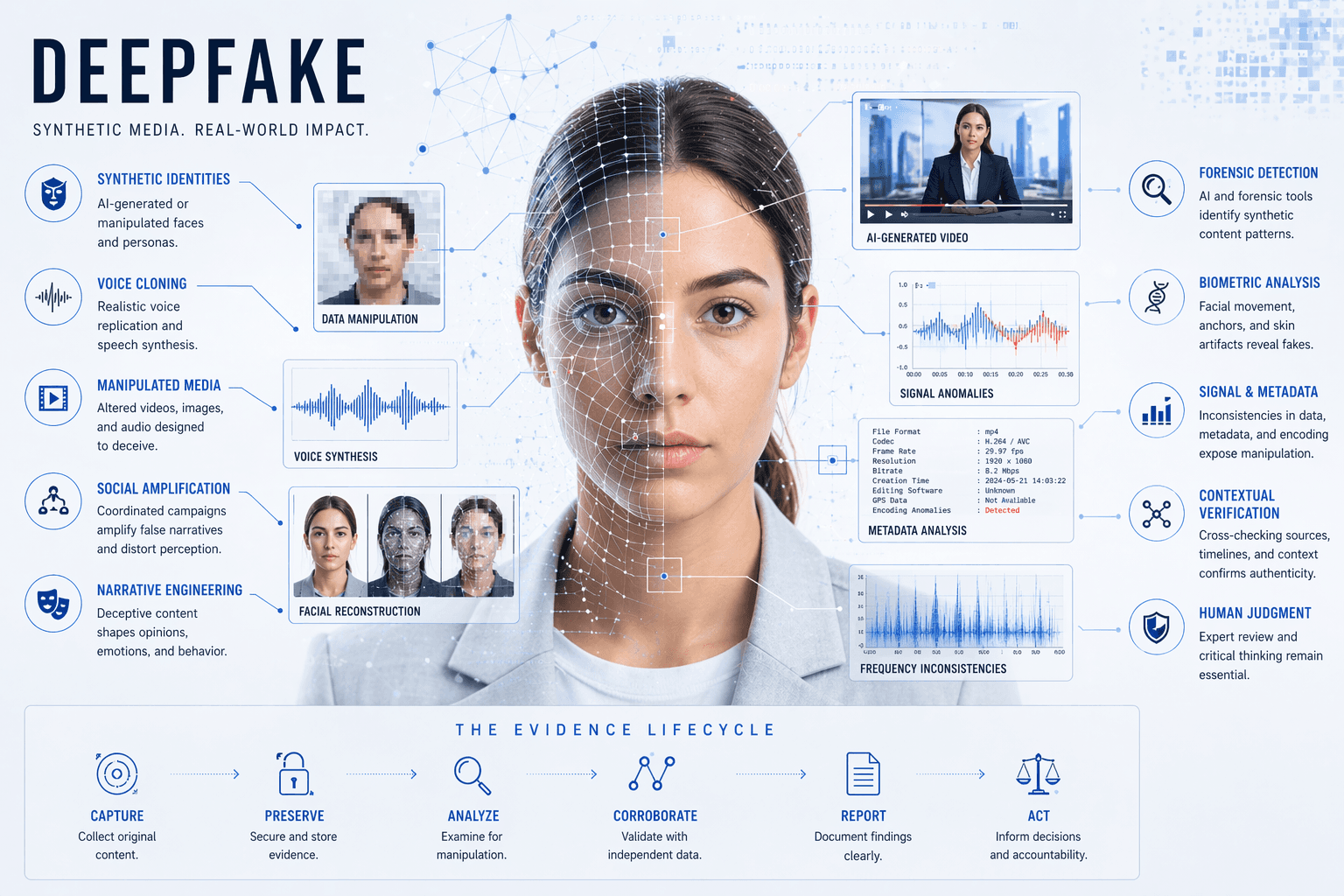
The reflex response is to build better detectors at the artifact level: a classifier that spots tells in a single file. Artifact-level detection has real value and belongs in any serious stack. On its own, it is the wrong battle.
Controlled studies consistently show that humans cannot reliably distinguish authentic from synthetic media when shown a single piece in isolation, even when warned and incentivized. Automated detectors operating on one artifact face a similar ceiling. They are locked in an arms race with generative systems that set the pace, and every advance on the detection side trains the next generation of synthesis.
But investigations are rarely built on one file in isolation. They are built from the correlation of many signals: communications, transactions, location data, independently captured recordings, documentary and testimonial context. A deepfake that survives a frame-level classifier is a much harder thing to embed inside a corroborated, cross-referenced body of evidence without leaving inconsistencies somewhere. The surrounding signals do not have to be impossible to fabricate. They only have to be independently sourced enough that coordinated fabrication across all of them becomes infeasible at the attacker's scale.
This is where the work shifts, and it is the core of this piece. Authenticity is no longer a property you can read off the surface of an artifact. The artifact itself — the pixels, the waveform, the file — tells you less and less. What tells you more is the intent behind the evidence: what it is meant to establish, what it is meant to show, and whether the surrounding signals support or contradict that meaning. The question stops being "is this one video real?" and becomes "does this video fit with the timeline, the communications, the movement data, and the other recordings in the case?" Authenticity becomes a question of intent and coherence across sources, not surface appearance. That is a harder problem to fabricate and a more tractable problem to analyze.
The Legal Scaffolding Is Forming, Slowly
Courts and legislatures are aware. A proposed Federal Rule of Evidence 707 would subject machine-generated evidence to expert-testimony-level reliability standards, and a public hearing was held in January 2026. State-level rules are moving in parallel: Louisiana's Act 250 imposes a diligence obligation on attorneys, California's Judicial Council was tasked with issuing rules by the start of 2026, and national court-administration bodies have published bench cards for judges.
The limitation of all of it is structural. These rules address evidence a party acknowledges as AI-generated. The harder problem, and the one closer to the investigator's daily reality, is evidence presented as authentic that is not. Rules allocate burdens. They do not manufacture the forensic certainty the burdens require.
Provenance, Correlation, Judgment
The durable answer has three layers. No single one of them is the product.
Provenance at capture. Instead of treating every piece of digital evidence as a forensic puzzle solved after the fact, evidence is tamper-sealed the moment it is captured: cryptographically signed at the sensor, bound to device and context metadata, and carried through its lifecycle with the seal intact. Standards like C2PA formalize this, and chain of custody starts moving upstream into the camera, the recorder, the intercept appliance.
Multi-source correlation. This is where the pattern-versus-pixel argument actually operates. Cross-referencing independent streams — comms, movement, transactions, other recordings — makes a single fabricated artifact stand out by virtue of what it fails to align with. Platforms that help analysts pull signals across sources, pivot between them, and surface inconsistencies are doing something single-file detection cannot: making fabrication harder as the scope of the case grows, not easier.
Analyst judgment, augmented. No automated stack carries the full weight of authenticating evidence in high-stakes matters. The analyst's role is moving up, from mechanical review toward contextual judgment about what a body of evidence, taken together, is actually saying. AI tooling works best here when it is transparent, auditable, and built into the workflow rather than around it.
Provenance without correlation is brittle. Correlation without provenance is contested from the start. Either without trained judgment is shelfware. The stack is all three.
What This Means for Practice
Three directional shifts, not a checklist.
Assume contest. Every substantive piece of digital evidence will be challenged on authenticity grounds. Case preparation should begin from that assumption, and a case built on a single exhibit is now materially weaker than one built on a corroborated body of evidence, even when every pixel is genuine.
Invest in the correlation layer. The defensive advantage in the deepfake era comes from pulling signals across sources and showing the internal consistency of the whole. Tooling that supports that workflow, and analysts trained to use it, are where cases will be won or lost.
Train for the liar's dividend. Investigators and the attorneys downstream of them need to understand the dynamic before they meet it in front of a jury. Anticipating the deepfake defense is cheaper and more effective than reacting to it.
Closing
Truth used to be the default and fabrication was the exception. That arrangement has inverted, and the work of establishing what actually happened now happens on contested epistemic ground. The investigator's craft is no longer reading authenticity off the surface of an artifact. It is assembling the pattern of signals around it and reasoning about what the whole configuration is meant to convey.
The artifact alone can no longer tell you what is real. The intent behind it — what the evidence is meant to establish and whether the surrounding signals corroborate that meaning — can. The infrastructure for that kind of work (provenance where we can get it, correlation across sources where we can build it, and analytical judgment sitting on top) exists and is maturing. The question for the next several years is whether it gets adopted at the speed the problem actually requires.